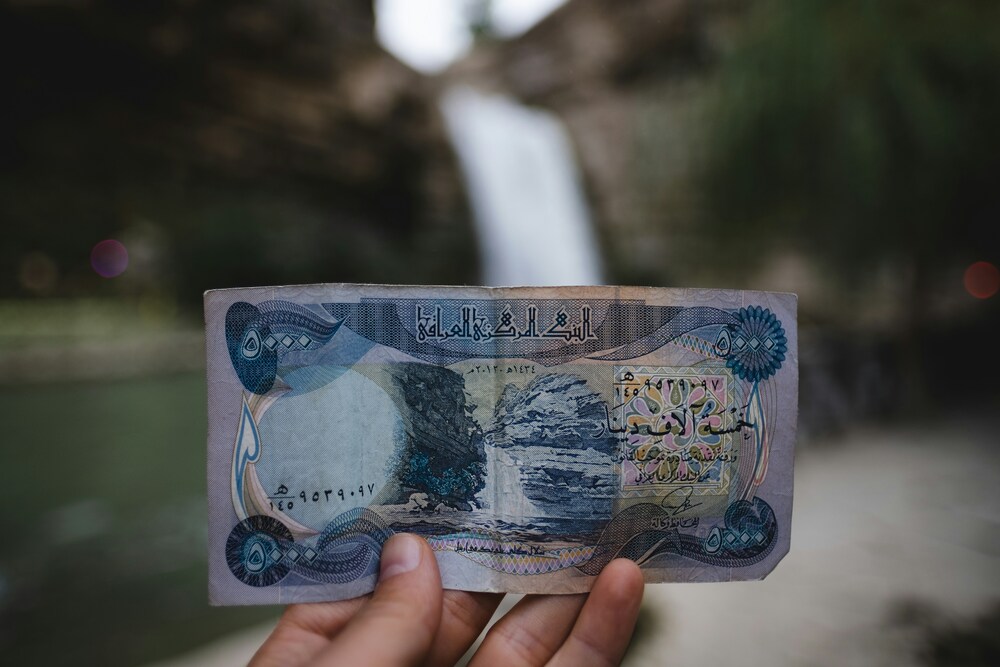

The recent decision by the Central Bank of Iraq to issue an additional 25 trillion dinars in order to finance government expenditures has reignited debate about the country’s economic future. Much of the discussion has focused on inflation, liquidity shortages, exchange rates, and the risks associated with expanding the money supply during a period of declining oil revenues.
These concerns are valid.
Iraq remains one of the most oil-dependent economies in the world. When oil revenues fall, the entire financial structure of the state immediately comes under pressure. The recent disruption of exports through the Strait of Hormuz exposed this vulnerability once again. With government spending heavily reliant on oil income, Baghdad was forced to find alternative ways to maintain public expenditures and avoid a financial crisis.
However, focusing solely on monetary policy misses a much deeper problem.
The real challenge facing Iraq’s financial system is not simply inflation or liquidity.
It is trust.
Every successful banking system in the world is built on confidence. People deposit money into banks because they believe their savings are secure. Businesses invest because they trust the financial system to function predictably. Investors commit capital because they have confidence that institutions will protect property rights, enforce contracts, and maintain economic stability.
Without trust, banking systems struggle regardless of how much money is available in the market.
This is where Iraq faces one of its most serious long-term problems.
For decades, Iraqis have learned through experience to be cautious when dealing with state institutions. Wars, sanctions, economic collapse, political upheaval, corruption, currency instability, and institutional failure have all contributed to deep skepticism toward the state’s ability to manage economic affairs effectively.
That skepticism has only been reinforced by years of corruption scandals, the accumulation of enormous wealth by politically connected figures, the transfer of capital abroad, the growing influence of militias over economic activity, and repeated legislative and regulatory changes widely perceived as serving the interests of powerful groups rather than the public.
For many Iraqis, these are not isolated incidents but part of a broader pattern that has steadily eroded confidence in the state’s institutions and its ability to act in the national interest.
Many Iraqis still remember periods when savings lost value, when institutions failed to function properly, and when political decisions directly affected economic stability. The result is a population that often places greater confidence in cash, gold, real estate, foreign currencies, or overseas assets than in domestic financial institutions.
For those fortunate enough to have the means, wealth is often transferred abroad. However, this option has never been available to most Iraqis. Visa restrictions, residency requirements, banking limitations, and decades of political instability have made it difficult for many citizens to establish financial security outside the country.
The reality is that much of Iraq’s previous generation of private investors, entrepreneurs, business owners, and professionals left years ago. Many relocated their wealth, businesses, and expertise elsewhere, taking with them not only capital but also confidence in Iraq’s long-term economic future.
Those who remained often learned to preserve wealth through direct control of assets rather than trust in institutions, a mindset that continues to shape financial behaviour today.
This reality can be seen everywhere.
Despite repeated government efforts to modernize the banking sector and expand financial inclusion, enormous amounts of wealth remain outside the formal banking system. Large quantities of cash are stored in homes and businesses. Property continues to serve as a preferred store of value. Demand for dollars remains high. Whenever uncertainty increases, many Iraqis instinctively seek ways to move assets away from the local financial system rather than deeper into it.
This behaviour is a rational response to decades of instability.
Trust is earned through experience.
Unfortunately, the experiences of many Iraqis have often reinforced caution.
The recent expansion of the money supply risks deepening these concerns. When citizens see large amounts of new currency being issued to finance government obligations, questions naturally emerge about inflation, purchasing power, and the long-term value of the dinar. Whether these fears ultimately prove justified becomes secondary. What matters is that people believe there is reason to worry.
Perception plays a central role in economics.
Banking systems do not operate solely on mathematical models and balance sheets. They operate on public confidence. Once people begin questioning the stability of a financial system, behaviour changes rapidly. Savings are moved elsewhere. Investment decisions become more conservative. Capital seeks safety. If the trust was never there, then it calls into question the past 20 years of the so called “economic development”.
This creates a self-reinforcing cycle.
Low trust encourages people to keep money outside the banking system. A weaker banking system then has fewer resources available to finance economic activity. Private sector growth remains limited. Investment slows. Economic development weakens. Confidence declines further.
The cycle repeats itself.
What makes Iraq’s situation particularly difficult is that trust in the banking sector cannot be separated from trust in the political system.
Banks do not operate independently from the broader environment in which they exist. They function within institutions shaped by laws, regulations, courts, governments, and political realities. When confidence in those institutions weakens, confidence in the banking sector weakens as well.
This is why purely technical reforms often struggle to achieve meaningful results.
New banking regulations can be introduced.
Electronic payment systems can be expanded.
Financial technology can be promoted.
Banking infrastructure can be modernized.
But none of these measures can solve the fundamental issue if public confidence remains low.
Trust cannot be printed like currency.
It cannot be legislated into existence.
It cannot be created through public relations campaigns.
Trust emerges when institutions consistently demonstrate competence, transparency, accountability, and stability over long periods of time.
Many Iraqis simply do not believe those conditions currently exist.
This is perhaps the greatest obstacle facing the country’s financial future.
The issue extends beyond banking itself. Trust influences every aspect of economic development. Investors are less willing to commit capital. Entrepreneurs become more cautious. Businesses delay expansion plans. Skilled professionals seek opportunities abroad. Citizens focus on protecting existing assets rather than creating new wealth.
The broader economy ultimately pays the price.
For this reason, the current debate should not be limited to questions about money supply, exchange rates, or short-term budget pressures. Those issues matter, but they are symptoms of a deeper problem.
The real issue is whether Iraq’s institutions are capable of rebuilding public confidence after decades of instability and disappointment.
At present, there is little evidence that this process has begun in any meaningful way.
Successive governments have promised reform. Corruption remains widespread. Public services remain weak. Political fragmentation continues. Economic diversification has made limited progress. Confidence in state institutions remains fragile.
Under these conditions, expecting trust in the banking system to recover quickly may be unrealistic.
Trust takes years to build and moments to destroy.
Iraq’s financial system is now dealing with the accumulated consequences of more than two decades of political instability, economic uncertainty, and institutional weakness. While monetary measures may provide temporary relief, they do not address the deeper issue.
Until Iraq develops institutions that citizens genuinely trust, large portions of wealth will continue to remain outside the banking system, confidence will remain fragile, and the country’s economic potential will continue to be constrained.
The banking crisis is about trust.
And trust remains one of the scarcest resources in Iraq today.