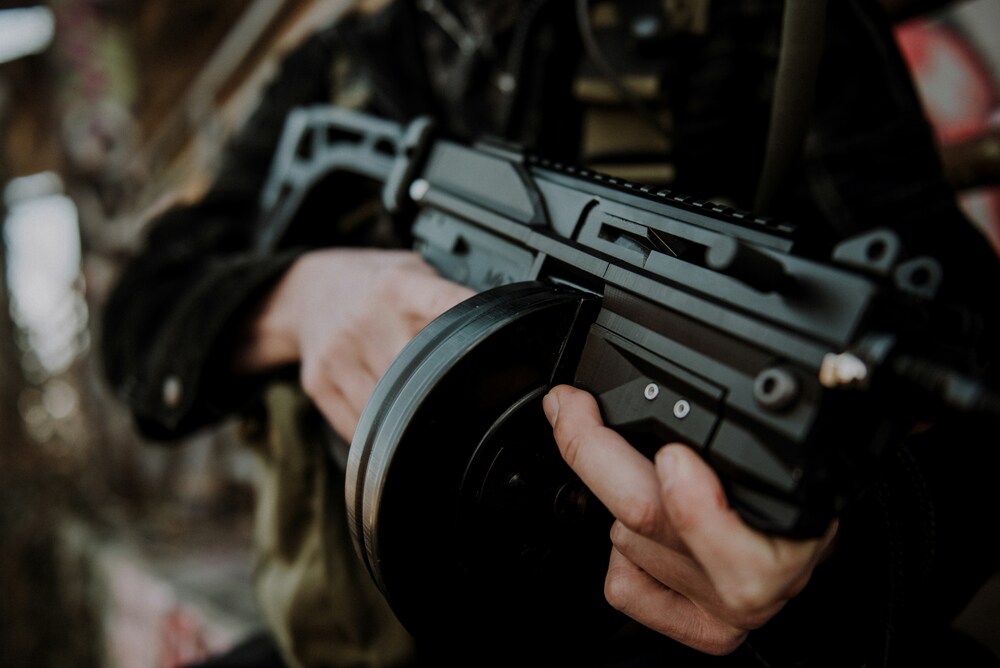

Iraq’s political and economic system cannot be understood without examining one of its most defining features: the presence of armed groups operating both within and beyond the state. Armed militias shaping institutions and parliament as they see fit, backed by a corrupt political establishment that was installed after the 2003 US invasion.
These groups are often described as “non-state actors.” In reality, many of them are deeply embedded within the state itself, operating through official structures while maintaining independent chains of command. Loyalty is not to the state, but to political figures and external actors.
And this is not new. This is how the system evolved after 2003, first enabled during the occupation by the US, then reinforced over time through regional influence, mainly Iran. Many of these groups were later formalised within state structures, receiving salaries and recognition while continuing to operate with significant autonomy.
What has emerged over the past two decades is a hybrid system where armed groups, political parties, and state institutions are interconnected. It is a structure that is deliberately difficult to dismantle, creating a continuous cycle of dysfunction. The system sustains itself, benefiting external actors and neighbouring countries while depriving the Iraqi population of basic services, opportunities, and any real path toward growth or stability.
A parallel state became the system itself. If one falls, the other follows.
From Collapse to Consolidation
The origins of this system lie in the period following 2003. Early signs emerged when US and coalition forces began integrating militia groups, most notably the Badr Brigades, into plans for Iraq’s newly established security forces.
The dismantling of Iraq’s existing security institutions created a vacuum. In that space, multiple armed groups emerged, some locally formed, others returning from exile, many with external backing, especially Iran.
These groups were not operating in isolation. They were funded, supported, and in many cases actively encouraged. With access to money and influence, they were able to recruit individuals who were either ideologically aligned or driven by economic desperation.
At the same time, the decision to disband the Iraqi Army under Paul Bremer removed one of the few remaining national structures capable of maintaining order.
What followed was a restructuring of power, one that ensured these groups would expand their influence as the new system took shape.
This effectively neutralised potential threats to the emerging order.
Over time, these groups consolidated control over key sources of income, including oil smuggling networks and smaller ports, securing continuous financial flows that allowed them to expand recruitment and strengthen their position.
This financial independence made them increasingly difficult to challenge.
Operating with growing confidence, these militias evolved into entities that few could question. Their influence extended beyond security into daily life, where intimidation became routine.
Kidnappings, torture, and targeted killings became part of the landscape.
For many, there was no recourse and no protection. And this unfolded in full view of US and coalition forces.
Many of these armed groups were gradually integrated into newly formed security structures, including elements of the Iraqi Army.
Initially, these groups operated as independent forces by filling security gaps and advancing political and ideological agendas.
Over time, their role evolved. Rather than being dismantled or absorbed into a neutral national framework, many of these groups were gradually integrated into the state, without losing their autonomy.
This arrangement became structural.
Alongside this, smaller private security networks began to emerge. Not always formalised on paper, but very real in practice. These groups established offices, recruiting from the unemployed and the desperate, offering roles in providing protection for foreign companies, offices, shipping routes, ports, and other high-risk operations.
The justification was clear: the presence of armed resistance created demand for security.
But the reality was broader.
The occupation did not consist of military forces alone; it brought with it an entire ecosystem of foreign companies, contractors, and logistical operations, all of which required protection. These became targets, and in response, these semi-formal security entities expanded rapidly.
Over time, they became embedded within local environments.
Different groups began to establish control over specific areas, operating street by street, each attempting to influence and dominate its own zone of activity.
Many of those recruited later transitioned into roles within formal structures, providing security for politicians or joining the newly established army, police, and other state institutions.
But their loyalties did not fully shift.
In many cases, allegiances remained tied to the networks and groups they originally came from, carrying those influences directly into the institutions meant to replace them.
Institutionalisation Without Integration
The creation and expansion of formations such as the Popular Mobilisation Forces (PMF) marked a turning point.
This was, in many ways, the point of no return, which is why many are calling for the complete dismantling of the PMF.
The emergence of ISIL created the conditions for rapid mobilisation, and the formation of the PMF, backed by a religious call from Najaf and Ali al-Sistani, gave these groups both legitimacy and scale.
But this moment was not only about security.
It became an opportunity.
A system already shaped by corruption used this moment to consolidate power further, embedding armed groups more deeply into the structure of the state and expanding their influence under the banner of necessity and security.
The consequences were far-reaching.
Large segments of the Sunni population faced widespread repression, reinforcing the idea that any potential challenge to the system would be contained decisively.
At the same time, opposition was not limited to one group.
The Tishreen Movement, driven largely by young people from southern, predominantly Shiite regions, was also met with force. Despite claims of representation, those who challenged the system were treated as threats.
In the name of security and stability, dissent was suppressed.
Kidnappings, torture, and enforced disappearances became recurring patterns. Many remain missing to this day.
In Sunni-majority areas, entire cities were destroyed during operations against ISIL. The aftermath left deep scars, mass displacement, detentions without a clear legal basis, and ongoing reports of individuals being arrested and held without due process.
During this period, numerous other armed groups began to emerge, with different names, different leaders, but following the same model.
The logic became simple: those who could form an armed group could later secure funding through state channels or affiliated networks.
What began as a mobilisation increasingly turned into a business opportunity, a get-rich-quick scheme.
Over time, the formation of armed groups became, in many cases, a pathway to financial gain. Public funds and resources were directed toward maintaining these structures, turning them into sustained, well-funded entities.
Millions of dollars were, and continue to be, spent to support and expand these groups.
As their influence grew, many became involved not only in security but also in economic activity, extending into money laundering networks and private sector operations within Iraq.
What began as a mobilisation effort during a period of crisis was later formalised within the state apparatus. Salaries, recognition, and legal status were granted.
Funding continued to flow through multiple government channels, allowing these organisations to expand their reach well beyond security.
Over time, their influence extended into key areas of the private sector.
It is widely understood that many large projects, developments, restaurants, and service-based or retail businesses in Iraq are linked to these networks, often operating through front individuals to conceal ownership and control.
But institutionalisation did not mean integration.
These groups retained independent command structures, maintained separate chains of loyalty, and continued to operate with significant autonomy. In practice, they carried their methods into the state, practices defined by coercion, corruption, and control over local populations.
Reports and accounts over the years point to patterns of intimidation: forcing property sales, confiscation of assets, displacement of residents, and the use of detention, torture, kidnappings, and enforced disappearances to maintain authority.
Integrating such networks into the country’s security institutions does not restore order; it risks formalising and protecting the very behaviours those institutions are meant to prevent.
In practice, this created a system where multiple centres of power exist simultaneously, all interconnected.
Power Beyond Security
The influence of these groups extends far beyond security.
Over time, they have established a presence across key areas of the state and economy, including border crossings, trade routes, customs and logistics, reconstruction contracts, informal taxation networks, and money laundering operations.
This level of control allows them to generate revenue independently while also shaping economic activity.
In effect, parallel structures operate alongside the formal state, exercising authority, extracting resources, and imposing control over local populations.
What stands out is the persistence of this environment. Despite prolonged pressure, ranging from coercion and repression to ideological influence, the system has endured. In a country historically associated with political movements and uprisings that shaped the region, this continuity raises important questions about how power is maintained and resisted.
This influence also connects directly to the broader political and economic system described earlier.
Within Iraq’s parliament, many figures are closely linked to armed groups, some backed by them, others openly associated with militia structures while holding formal political positions.
Militias are not only security actors, they are economic actors.
From early on, ideological narratives were used not only for mobilisation, but as a cover for economic expansion, corruption, and the extraction of Iraq’s resources at scale.
Their involvement in contract allocation, protection arrangements, informal trade, smuggling operations, and resource flows places them firmly within Iraq’s political economy.
They operate as an economic force just as much as a coercive one.
This creates a mutually reinforcing system: economic resources sustain these groups, and in return, those groups protect and preserve the political and economic environment that enables them.
Each side depends on the other.
This interdependence makes meaningful reform extremely difficult. Public statements about disbanding militias are frequently made, but rarely followed by action, because dismantling them would mean dismantling the system that sustains the current corrupt political system.
Political Protection and Alignment
The relationship between militias and political parties is central to understanding their role.
Many armed groups are linked, formally or informally, to political movements. These relationships provide legal cover, access to state resources, and influence over policy and appointments.
Ministerial positions are widely understood to be negotiated between competing factions, often involving significant financial payments in the millions of US dollars. This pattern extends beyond senior roles, reaching deep into public institutions, where appointments at all levels can be influenced by affiliation, access, or payment rather than merit.
In return, political actors benefit from security backing, enforcement capabilities, and leverage over rivals.
Public disputes between political figures are often framed around corruption or governance, but in practice, they frequently reflect underlying competition over control of ministries, departments, and revenue streams. These conflicts are typically resolved through redistribution of positions, influence, and access, leading to temporary periods of stability. Which usually last for weeks or months rather than years.
This alignment blurs the distinction between political authority and coercive power.
Why They Cannot Be Easily Removed
Calls to dismantle militias or fully integrate them into the state have been frequent.
Yet these efforts rarely move beyond rhetoric.
The reason is structural. The system itself depends on the continued existence and role of these groups. Removing them would disrupt existing power balances, threaten political alliances, and cut off access to key economic resources.
Actually removing them would be a collapse of the current political system in place.
Such a shift would create space for the re-emergence of alternative political forces, including those currently marginalised, silenced, or in exile. Within Iraq, many remain unable to act openly due to fear of retaliation.
For those embedded within the current system, this represents a catastrophic outcome.
The implications extend beyond loss of power. A breakdown of the system would expose years of accumulated practices, corruption, violence, and abuses that could carry legal and political consequences. Many actors are deeply tied to this structure, and their survival depends on its continuity. A collapse would likely trigger an immediate attempt by many to flee the country.
Regional dynamics further reinforce this reality.
External support from Iran has played a significant role in sustaining the current system. Any shift in that support, particularly from Iran, would alter the balance of power and potentially accelerate change.
Public Perception and Shifting Legitimacy
Public attitudes toward militias have evolved over time.
In earlier periods, some groups were viewed as protectors, resistance forces, or necessary actors in times of instability. However, this perception has gradually shifted.
Events such as the Tishreen movement exposed a growing level of public frustration. For many, it became clear that the narratives and slogans used were often tied more to economic gain and corruption than to genuine representation.
The response from the state reinforced this view.
Militias and armed groups were used to suppress the movement, resulting in killings, arrests, torture, and disappearances.
As a result, many Iraqis began to see these groups not as protectors, but as part of the system that blocks reform and accountability.
Each year, this perception appears to strengthen. Calls for disbanding militias and restructuring security institutions to remove their influence are becoming more widespread.
This shift in public sentiment is significant. But it has not yet translated into structural change.
Meaningful transformation would require multiple factors aligning at the same time. Some of these conditions may be emerging, but the picture remains incomplete.
The Parallel State in Practice
Today, Iraq operates through overlapping layers of authority:
* Formal institutions (government, ministries, official security forces)
* Informal networks (political alliances, patronage systems)
* Armed groups with institutional recognition but operational autonomy
These layers do not function independently. They interact, compete, and cooperate simultaneously.
This is what defines the current state of Iraq.
It is embedded within the system itself. The system depends on their existence, and their dependence on the current political structure ensures their continuity.
This relationship sustains the flow of power and resources, generating significant wealth for both armed groups and political actors.
Implications for Reform
The existence of this parallel state has direct consequences for reform. Efforts to strengthen institutions, improve governance, or restructure the economy are consistently resisted or undermined.
Reforming the current system would directly threaten the financial foundations on which many political actors and armed groups depend.
For them, it is a direct threat to survival.
The system sustains access to money, influence, and protection. Disrupting it would mean dismantling those networks.
This is why meaningful reform remains unacceptable from within.
Losing power means losing access to resources.
And in this system, power and money are inseparable.
Conclusion
Iraq’s challenge is not simply the presence of militias; it is the system as a whole that must be fundamentally changed.
This system has allowed armed groups to operate within the state while remaining partially independent from it.
This duality lies at the core of Iraq’s political and economic reality.
The current structure cannot sustain itself without corruption, armed groups, and external influence. The moment these elements are removed, the system itself begins to collapse.
The parallel state is a defining feature of how power is organised.
Understanding it is essential to understanding why reform remains so difficult, and why the system continues to function as it does.
What is required is a fundamental rupture with what has been built over the past two decades.
Without a complete restructuring of the political order, the same cycle will continue, at the cost of future generations.